







2026.01.16
The Fire Horse Soars; Through Flourishing Virtue, Achievement, Prosperity, and Power
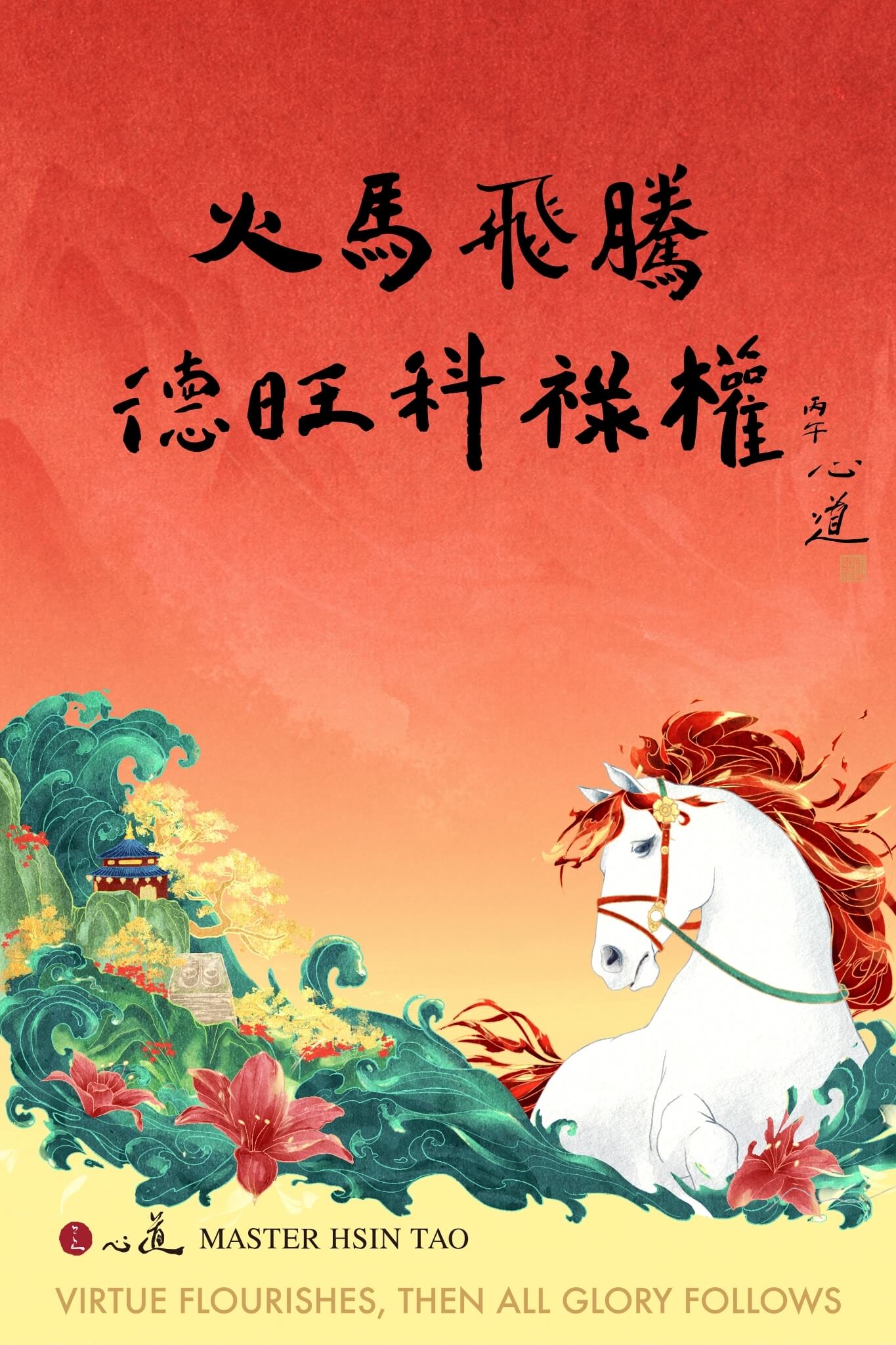 The year 2026 corresponds to the “Bingwu year” in the traditional sexagenary cycle and is also commonly referred to as the Year of the Fire Horse. In the face of the social and political instability associated with a Fire Horse year, one must develop stability within oneself through virtue (德dé). Without moral cultivation, the many disturbances will be difficult to endure. A world filled with virtue is one characterized by harmony and peaceful coexistence, in which beings relate to one another through interconnectedness and support. In the absence of virtue as a guiding principle, what are termed “achievement, prosperity, and power (科kē, 祿 lù, and權 quán)” tend toward destructive outcomes. Thus, in 2026, it is essential for us to cultivate virtue—both personally and in relation to society and the state—so that all people, affairs, and conditions may remain stable and at peace.
What is commonly described as “accumulating virtue,” particularly “hidden virtue (陰德yīn dé)” refers to the continuous accumulation of virtuous deeds. “Accumulation” here means steadily gathering good actions, rather than actively seeking out conflicts or problems; when one looks everywhere for trouble, everything appears troubled, and a sense of stability becomes difficult to sustain. Virtue is fundamentally oriented toward altruism: acting for the benefit of others at all times, offering assistance wherever possible, and fostering harmony without generating contention. Only then can society as a whole be filled with harmony. In such a flourishing society, “achievement, prosperity, and power” are all present and prosperous, each flourishing.
Each year, the themes of the coming year are articulated through Spring Festival couplets. For example, during the Year of the Snake, the couplet theme was “casting off the shell and abiding in ease,” signifying that only by letting go of attachment and delusive conceptions can one live well. Without shedding this “shell”—that is, without uprooting attachment—conflict and conceptions arise, and relationships become entangled in suspicion and calculation.
To take virtue as the primary principle, therefore, is not to engage in calculating others, but to perform generosity; it is to regard helping others as the foundation of happiness. Such virtue supports the growth of society and brings benefits to individuals, communities, and the nation alike. Only this kind of virtue constitutes genuine goodness.
Where, then, does our virtue now reside? The disorder of contemporary society and the divisions within the human heart call for serious reflection. For this reason, every individual must cultivate virtue. Only through virtue can mutual assistance and cooperation arise, enabling us to help others and collectively resolve problems.