






2026.10.05
Dharma Q & A: The Sun of Primordial Awareness
 Disciple: When we are dealing with matters, sometimes we go around in circles, and only then does a glimpse of primordial awareness emerge. Yet after appearing for an instant, it disappears again, and the mind becomes caught up in phenomena. What should we do to sustain such clarity of awareness?
Master Hsin Tao: It is like a lamp: it shines only when it is lit. We must light the lamp; when it goes out, we light it again. When the flame is small, raise the wick a little. Eventually raise it until the oil flows freely through the wick, and then it will burn brightly. When the oil and the wick are well connected, the lamp shines brightly.
Everything in the world is conditioned phenomena, like a dream, an illusion, a bubble, or a shadow. This is why we are often instructed to use the four-line verse of the Diamond Sutra as an object of contemplation. This is the view of life cultivated by practitioners. When you practice in this way, you will no longer carry burdens on your back; the only thing you take is the realization of emptiness. Since all phenomena are “like a dream, an illusion, a bubble, or a shadow; like dew and like lightning,” what is there substantial for us to carry?
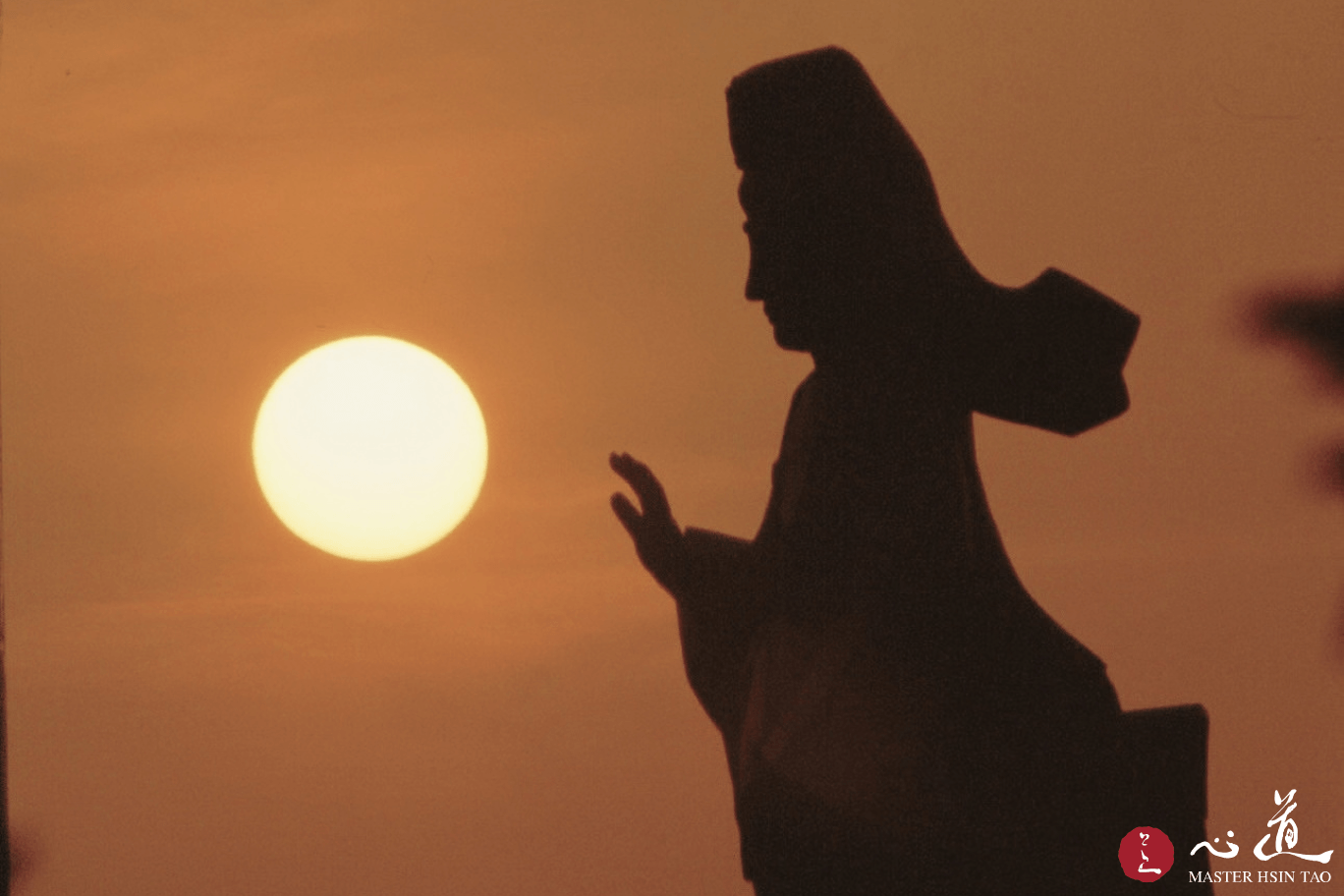
Everything will eventually dissolve without a trace. Over time, we will come to realize the true nature of emptiness. Thus, whenever afflictions arise in daily life, immediately bring this teaching to mind. It is like the moon rising and illuminating the darkness of night. If even greater luminosity is required, then the primordial awareness that is like the sun must arise. Thus, contemplation is intended to bring about the realization of true reality.
 Disciple: But when ignorance arises, how do we eliminate this ignorance?
Master Hsin Tao: It is not a matter of eliminating it. For example, when we lose our temper, this is a kind of mental waste. How do you throw it away? How do you let it to be digested?
This is why we must learn the Buddha’s teachings. The Dharma is unionized and unobstructed. What does it mean to be unionized? It means to be inclusive. And how can we be inclusive? By having space.
Without space, there can be no inclusivity. If the space is not vast enough, it cannot encompass things. Emptiness is a boundless expanse, like the open sky. Within this emptiness, all that is good and bad, right and wrong, virtuous and unvirtuous, neither increases nor decreases. Within this space, everything simply moves and fluctuates. This is what is meant by “self-arising, self-ceasing, and self-liberating.”
You do not need to manage it. It arises by itself and ceases by itself. After this has continued for a long time, you yourself will neither arise nor cease. In the beginning, there appears to be arising and ceasing; in reality, there is neither arising nor ceasing. This is the process of practice. Does it make sense?
Disciple: I understand, but I cannot put it into practice.
Master Hsin Tao: We first have intention or view, and only then do we take actions. Without thought, there is no action. We must first establish the right understanding, and then gradually put it into practice. To whatever extent you put it into practice, to that extent you will gain direct experience.
At the beginning, when you have practiced 10%, 20%, or 30%, you may feel miserable and think, “I cannot do it.” But once you have gone beyond 40% or 50%, perhaps even a little beyond that, you will feel, “Ah! This feels so nice.” Then you will continue practicing to reach 60%, 70%, and so forth.
When you have only practiced 10% or 20% parts, you may feel that you are no better off than before. You feel that you have no freedom at all, as though you are being tightly constrained, and it is unbearably painful. But once you have reached 60%—once you have gone beyond 50%—you will think, “Ah! This is wonderful!” You discover its benefits.
Therefore, when learning the Buddha’s teachings, the initial 10%, 20%, and 30% are very difficult to learn. Once you reach 40%, 50%, or 60%, it becomes much easier. What is required throughout this process is “patience in the face of adversity.”
Patience in the face of adversity means being inclusive. There is nothing in this world that is absolutely perfect. When the moon is full, it must wane; it cannot remain full forever. It becomes full, and it also becomes incomplete. Having imperfections is itself perfection. Yet you must not say that you have already achieved perfection—that would be the end of the matter.
 For example, when the Buddha sees the world, he sees it as brilliantly multicolored: everything is a manifestation of the Buddha’s wisdom. When we ordinary beings look at the world, however, we see so much good and evil, right and wrong, and good and bad. We regard it as a world afflicted by the five degenerations, thinking that it is not a place in which one can live and that it would be better never to have been born here. This is seeing the world through an ordinary worldly perspective.
If we see it through the Buddha’s perspective, however, it is complete and perfect. Everything is radiant with the five-colored light. Look at it—how beautiful are these colors, so varied and magnificent.
From the perspective of ordinary beings, however, it does not appear this way. Therefore, there is nothing in this world that is absolutely perfect. If you are a perfectionist, you will suffer.